
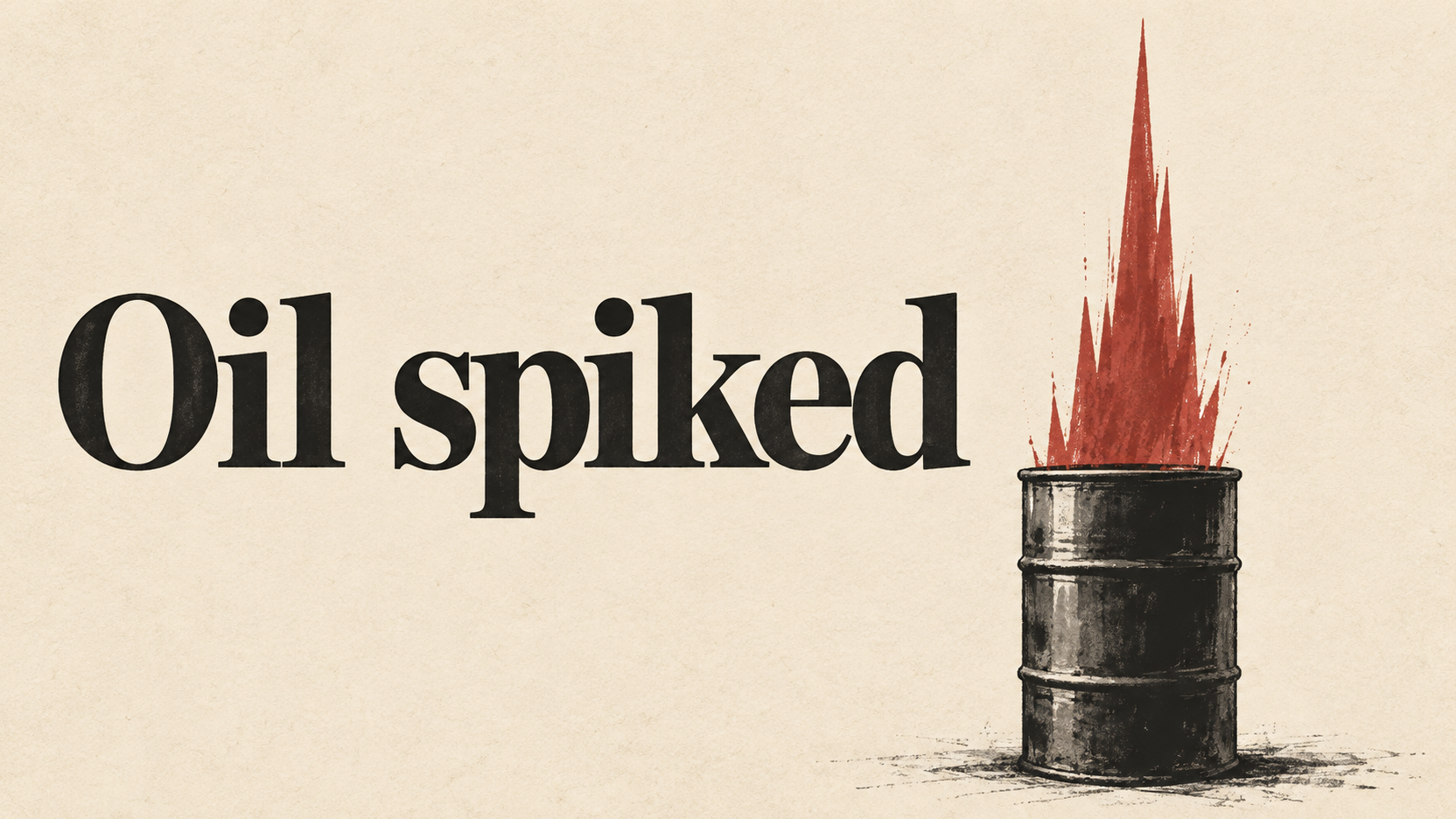
A Houthi missile strike on Saudi Arabia sent Brent crude spiking to $108 a barrel and WTI to $97 on Thursday, before Iran signaled openness to a Hormuz-related arrangement at the UN, paring the gains back to roughly $107 and $95 respectively. The energy jolt landed on a market already unsettled by rates: the 10-year Treasury yield pushed to a fresh overnight record of 5.225% — its highest since 2007 — and the 30-year touched 5.502%, as hawkish Fed rhetoric and the fresh inflation scare from oil kept bond markets on the back foot. The Dow Jones Industrial Average is now on track for a fourth straight losing week.
What to watch
Advance durable goods orders land at 8:30am ET, followed by the final University of Michigan consumer sentiment survey at 10:00am ET. The next FOMC meeting is October 28, and markets are currently pricing roughly 73% odds of another 25-basis-point rate hike — not a cut. The Fed raised rates 25bp on September 16 to a target range of 3.75%-4.00%, its first hike since 2023, and Fed Governor Michael Barr has said further tightening will likely be needed if inflation doesn't cool.
Markets
US stocks closed lower Thursday: the S&P 500 fell 0.51%, the Nasdaq Composite dropped 0.78%, the Dow shed 0.32% and the small-cap Russell 2000 gave up a sharper 1.77%. Friday's premarket futures were little changed — S&P futures down 0.05%, Nasdaq futures fractionally higher, Dow futures up 0.01% — as Asian trading was mixed overnight: Japan's Nikkei 225 gained 1.06% and the Topix rose 1.19%, while Australia's ASX 200 slipped 0.46% and Hong Kong's Hang Seng fell 1.69%. Mainland China and South Korea were closed for a holiday. In Washington, the Trump-Xi state visit continued with expectations for concrete deliverables kept deliberately low.
In Europe, Thursday's close was broadly lower: the FTSE 100 fell 0.24% to 10,679.99, the DAX dropped 0.61% to 25,255.92, the CAC 40 lost 0.52% to 8,081.43, and the Stoxx 600 was down 0.6%, all pressured by the same combination of higher oil prices and rising bond yields hitting Wall Street.
Commodities
Brent crude's intraday spike to $108 on the Houthi strike eased back to around $107 after Iran's UN signal on a possible Hormuz deal; WTI peaked near $97 before settling around $95. Gold held roughly steady near $4,286 an ounce.
Crypto
Bitcoin traded at $84,237 as of 05:55 UTC Friday, down 0.2% from the 00:00 UTC open of $84,410, holding an overnight range of $84,061 to $84,888 — a quiet, rangebound session with no directional catalyst. Ether traded at $2,681.46, down 0.25% from its $2,688.05 open. Other majors moved in the same narrow band: SOL at $116.49 (-0.5%), BNB at $774.76 (-0.25%), XRP at $1.5294 (-0.35%) and DOGE at $0.09509 (-0.7%), with no standout mover among the group.
What it means for crypto trading
With the Fed pricing in another hike rather than a cut at the October 28 meeting, and Treasury yields still climbing to fresh multi-decade highs, crypto remains tethered to the broader rates and risk-off trade rather than moving on its own catalysts. The nearer-term wildcard is a further Middle East energy shock — the Houthi strike on Saudi Arabia being the latest instance — spilling into risk sentiment broadly; bitcoin's own overnight action stayed notably quiet while equities and bond yields did the moving.
Sources:
- CNBC — Stock futures are little changed as Dow heads for fourth straight losing week
- TheStreet — Stock Market Today (Sept. 24, 2026)
- Eastern Herald — Brent Hits $108 on Houthi Strike, Falls as Iran Floats Hormuz Deal at UN
- Fortune — Current price of oil as of September 24, 2026
- Fortune — Current price of gold: September 24, 2026
- CNN Politics — Trump greets Xi with lavish fanfare, but expectations for the summit remain low
- CNBC — Fed Governor Barr says he'll support rate hike if inflation doesn't ease