
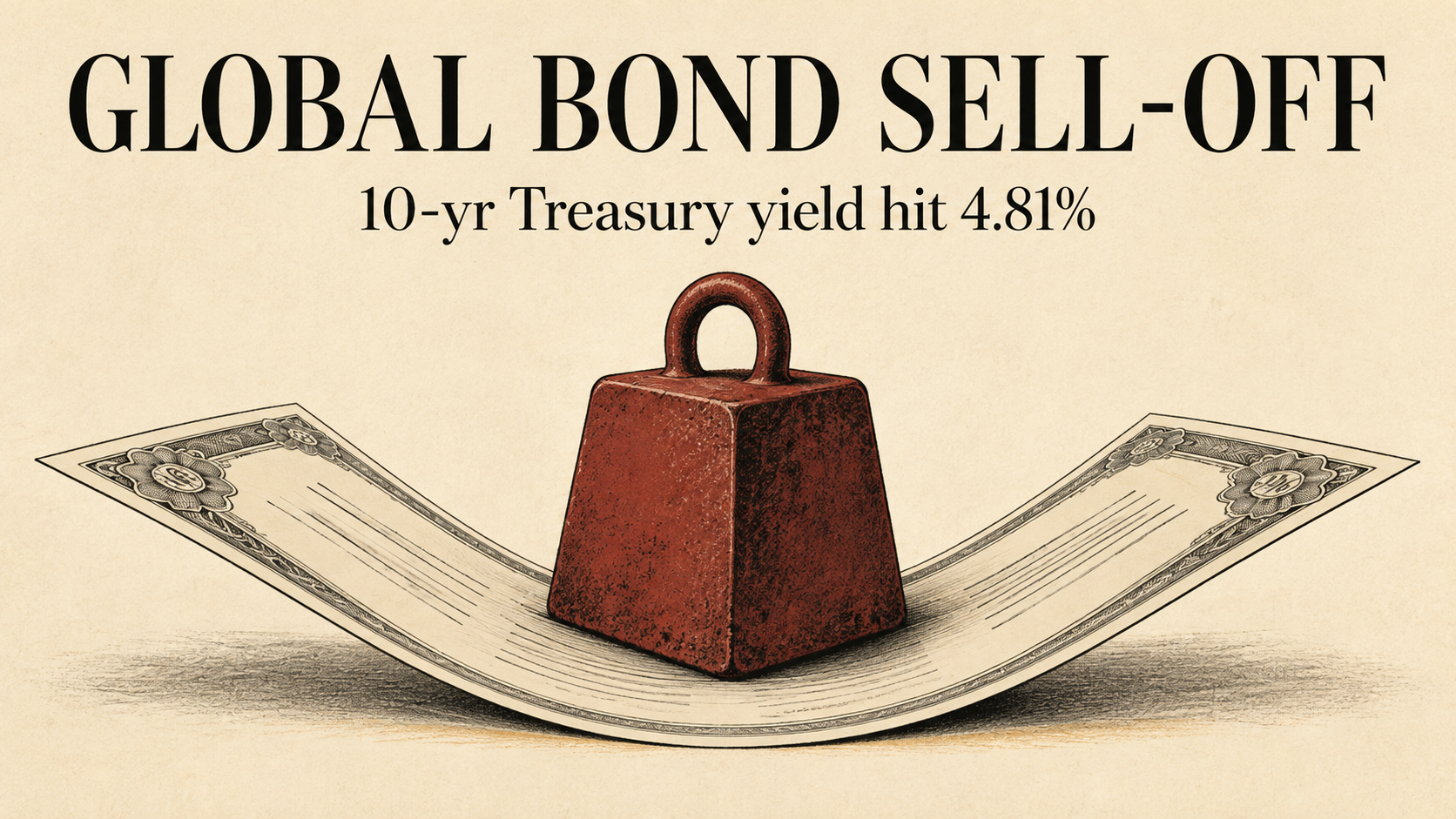
Global bond markets sold off sharply as of Wednesday's close, September 2, with the 10-year Treasury yield climbing to 4.81% — its highest level since November 2023 — as renewed fighting between Israel and Iran collided with a fast-shifting Fed outlook. Markets are now pricing roughly 66% odds of a 25-basis-point Fed hike this month, up from about 40% a week earlier, a striking reversal from the rate-cut narrative that had prevailed for much of the year. US equities nonetheless closed higher on Wednesday even as yields ran up.
What to watch
Thursday, September 3 brings initial jobless claims, the ISM Services PMI for August (consensus 54.5), the July trade balance and final Q2 unit labor costs/productivity, all due at 8:30am–10:00am ET. The August jobs report follows Friday, September 4. The FOMC next meets September 15–16, with market pricing now leaning toward a hike rather than a cut.
Markets
The S&P 500 rose 0.46% to 7,666.60 on Wednesday, the Nasdaq Composite added 0.45% to 26,217.83, and the Dow Jones Industrial Average gained 0.56% (+295.07 points) to 53,061.95, as Treasury yields took a brief pause from their run-up. Futures pointed to a flat-to-slightly-lower open Thursday (S&P futures -0.04%, Nasdaq 100 futures -0.1%, Dow futures little changed) amid renewed US-Iran tension.
In Europe, the mood was more downbeat: the FTSE 100 fell 0.32% to 10,789.28, the DAX dropped 1.10% to 25,970.11 — the hardest-hit of the majors — the CAC 40 slipped 0.39% to 8,301.85, and the Stoxx 600 hovered near one-month lows, down 0.1%. The renewed Middle East fighting pushed oil higher and stoked inflation and tighter-policy concerns, while European government bond yields climbed in step with the global sell-off.
Commodities
Brent crude traded near $96.11 a barrel and WTI around $90.72, both elevated on the Israel-Iran escalation. Gold, by contrast, slipped to roughly $4,334 an ounce (December futures $4,377.20, -0.4% on the day) as rate-hike bets — rather than cut bets — weighed on the metal.
Crypto
Bitcoin traded around $76,597 and ether around $2,374.18, down 3.10% over 24 hours and 3.30% over the past week, both pressured by the reignited Iran war and building Fed rate-hike expectations.
On regulation, the SEC advanced its "Regulation Crypto Assets" proposal — the agency's first permanent rulemaking for digital assets, per Chairman Paul Atkins — laying out pathways for crypto issuers to raise capital under federal securities law and a safe harbor once an issuer's managerial efforts under an investment contract are complete. Separately, the CLARITY Act is widely seen as dead for 2026 after missing its legislative window when the Senate adjourned for August recess without a vote.
What it means for crypto trading
The live risk factor is a hawkish Fed repricing — hike odds rising, not cuts — layered on top of Middle East escalation. Rising real yields, with the 10-year at a 2.5-year high, are compressing risk appetite across equities and crypto alike; any oil-driven inflation surprise or a firmer Fed hike signal ahead of the September 15–16 FOMC meeting would likely extend the bitcoin and ether drawdown.
Sources:
- CNBC — Stock market today: Live updates
- CNBC — 10-year Treasury yield hits highest level since November 2023 as global bond sell-off continues
- Bloomberg — Traders rush to hedge portfolios as Treasury yields approach multiyear highs
- Forbes — Treasury yields hit 19-month high as inflation and rate-hike fears climb
- Yahoo Finance — Gold price today: Gold slips further as military actions escalate in Iran
- Fortune — Current price of oil as of September 2, 2026
- Yahoo Finance — Bitcoin and ethereum prices today: Crypto prices tumble as Iran war reignites
- CoinDesk — US SEC proposes first major crypto rule in surprise announcement
- CNBC — Crypto enters September with legislative policy gamble hanging by a thread
- Markets Today — US economic calendar, week of August 31 to September 4, 2026
- Hargreaves Lansdown — Europe open: Stoxx 600 sets new highs as win streak continues