
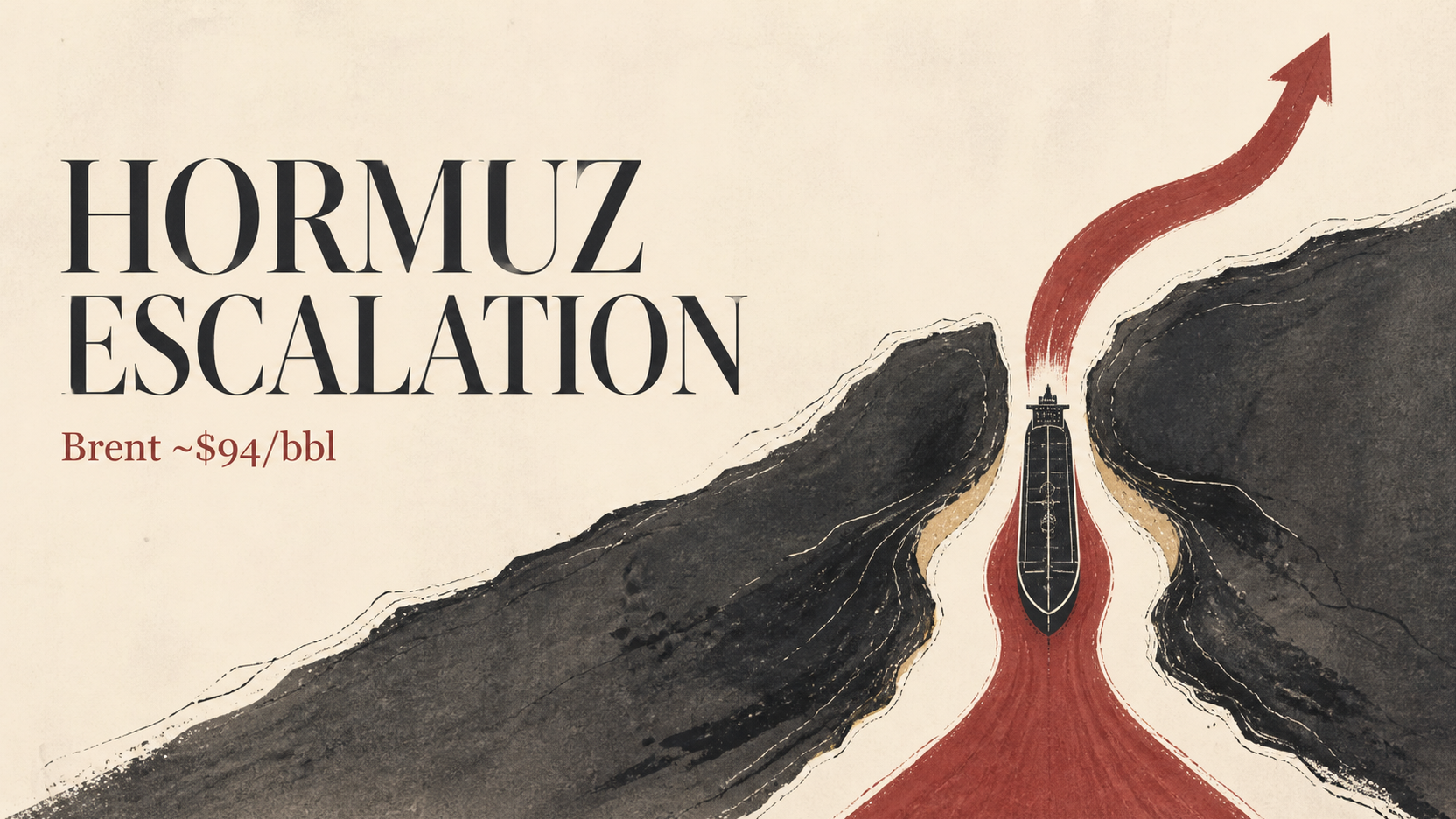
September opened with a risk-off session across markets as renewed US-Iran conflict in the Strait of Hormuz — two tankers, one Saudi-owned and one South Korean-owned, hit by projectiles overnight — sent Brent crude toward $94 a barrel and drove a global bond selloff. The 10-year Treasury yield sat near 5%, and the 30-year has now spent 55 days above 5% in 2026, the most of any year since 2006.
Markets
US indices closed lower as of the September 1 session: the Dow Jones Industrial Average fell 0.7% (-374.09 points) to 53,185.90, the S&P 500 slipped 0.3% to 7,686.14, and the Nasdaq Composite eased 0.1% to 26,370.89. Chip stocks bore the brunt of the selling — the iShares Semiconductor ETF (SOXX) fell 2%, Intel dropped 3%, Micron fell 3.1% premarket, and Nvidia and AMD also slipped — as higher yields hit high-multiple growth names on top of rate-hike fears tied to Fed Chair Kevin Warsh's recent hawkish comments on sticky inflation.
In Europe, the FTSE 100 fell 0.32% to 10,789.28, the DAX dropped 1.10% to 25,970.11 — the weakest of the major indices, led lower by rate-sensitive industrials — and the CAC 40 fell 0.39% to 8,301.85. All three tracked the same Hormuz-and-yields story driving US markets.
Commodities
Brent crude rose toward $94 a barrel on the tanker attacks and fears of further disruption to a strait that handles roughly 20% of world oil traffic. Gold, by contrast, fell to around $4,331-$4,350 an ounce, a two-week low, as rising rate-hike expectations outweighed the usual safe-haven bid from geopolitical tension.
Crypto
Bitcoin fell to about $77,946 as of mid-morning ET, giving back an earlier gain after opening near $78,559 (itself up 1.1% from Monday). Ethereum fell to roughly $2,454, down from an opening near $2,467. Both tracked the broader risk-off move seen across gold and equities rather than trading on their own catalyst.
On regulation, the SEC's newly proposed "Regulation Crypto Assets" framework (announced mid-August) continues to advance alongside deepening SEC-CFTC harmonization — joint interpretive guidance, a CFTC Innovation Task Force, and a shared five-category taxonomy for crypto assets. The industry's bigger legislative bet, the Clarity Act market-structure bill, remains stalled, with little confidence among executives that it clears Congress this session.
What it means for crypto trading
Crypto is currently trading as a rate-sensitive risk asset rather than decoupling on its own regulatory narrative. The SEC-CFTC framework progress is constructive medium-term, but today's move was driven by the same forces hitting equities and gold: a hawkish Fed repricing toward a September rate hike, amplified by an oil-driven inflation shock from the Hormuz escalation. A further escalation there, or continued hawkish Fed commentary, is the nearer-term downside catalyst to watch — not a regulatory deadline.
Sources:
- Yahoo Finance — Stock Market Today (Sept. 1, 2026): Nasdaq slides on renewed U.S.-Iran conflict
- STL.News — Overseas Markets Overnight — September 1, 2026
- Yahoo Finance — Gold prices today, Tuesday, September 1, 2026
- Fortune — Current price of oil as of Sept. 1, 2026
- Yahoo Finance — Bitcoin and ethereum prices today, Tuesday, September 1, 2026
- CNBC — Crypto enters September with legislative policy gamble hanging by a thread
- 24/7 Wall St. — Semiconductor Stocks Slide as Global Bond Selloff Lifts Yields
- DefiRate — September Fed Rate Predictions & Odds