
In the trading system I am building, crossing the take-profit barrier does not have to end a trade. It can be the point where the strategy stops waiting for a target and starts protecting a winner: follow the best price, give the move some room, and close only when it turns back.
The awkward part is deciding how much room is enough. Close too tightly and ordinary market noise cuts short every good move. Wait too long and a profit that was already available leaks away.
My first instinct was that this should be a dynamic decision. I already had a calibrated one-minute direction signal, so why not let a confident model loosen the trailing stop and tighten it when confidence fades? It is a plausible idea—and exactly the kind of plausible idea that needs a backtest before it finds its way into a trading system.
Isolating the exit decision
I built a separate research pipeline for this exit experiment using BTCUSDT aggregated trades from January 2024 to January 2026. It reconstructs the top of the book, buys at the ask and values the exit at the bid, so the test has to cross the spread rather than pretending every trade happens at the last price.
The entry side is deliberately fixed. I take opportunities where the calibrated direction score is in roughly its top 5%, then keep only the positions that reach a 30 bps profit barrier before a 20 bps stop or a two-hour timeout. That leaves 602,400 winning positions. Closing immediately at the barrier is the baseline, worth 15.64 bps per trade net of fees.
From that same decision point I replayed several trailing exits. Each one follows the bid to a new
peak, then closes after giving back a fraction g of the best profit seen so far. With g = 0.10,
for example, a trade that reaches 50 bps of peak profit is allowed to retreat by 5 bps before it is
closed.
I tested fixed values from 1% to 30%. I also tested the idea I was more interested in: a dynamic rule that recalculates the give-back from the latest model score. Weak confidence pulls the leash tight; strong confidence allows as much as a 30% give-back.
This is a paired exit experiment, not a portfolio backtest. The candidate positions overlap, so I would not add their PnL together and call it a realizable return. What I can compare cleanly is how each exit behaves on exactly the same set of winning trades.
The boring rule wins
The best fixed result came from g = 0.10, which added 1.96 bps per trade over closing at
the barrier—a 12.6% uplift on the baseline. It was positive in all 25 months in the sample and
kept a position open for only another 54 seconds on average.
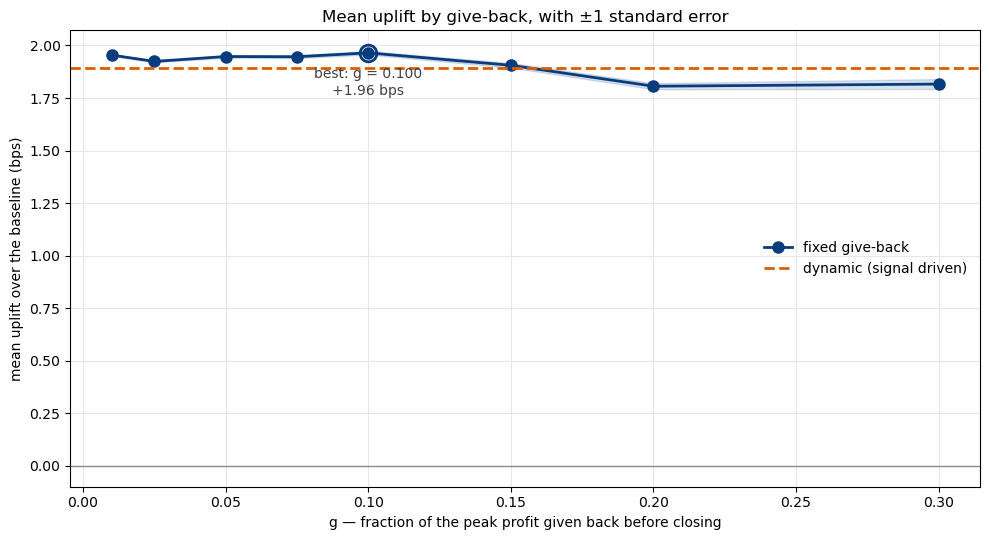
I would not read too much into 10% being the highest dot on the chart. The useful result is the shape of the curve: it is remarkably flat. A 1% give-back added 1.95 bps; 5% added 1.95 bps; 15% still added 1.91 bps. Even the much looser 20% and 30% rules remained profitable against the baseline, although they held positions longer for less average uplift.
In other words, trailing the winner mattered much more than finding a perfect trailing parameter. Ten percent is a sensible default, not a magic number.
Winning less often can still make more
The average hides the most interesting part of the result. The 10% rule improved only 49.5% of trades. Its median uplift was actually slightly negative. It still won overall because the moves that continued running created a long right tail large enough to pay for all the small give-backs.
Tighter rules feel better trade by trade. The 1% rule beat the baseline almost 70% of the time and closed after another 12 seconds on average. Looser rules are the opposite: the 30% rule improved only 36% of trades, but occasionally stayed with a much larger move.
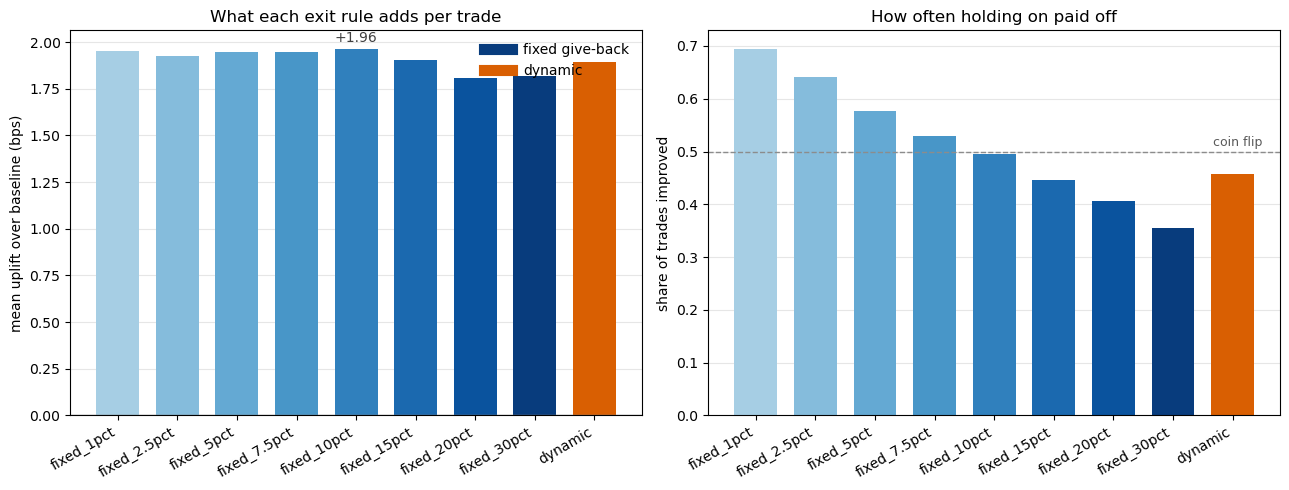
That is the real trade-off. A tight trail collects many small improvements. A loose trail accepts frequent small disappointments in exchange for rare, outsized winners. Looking only at win rate would choose the wrong exit.
The signal did not know when to hold
The dynamic rule added 1.90 bps per trade, just short of the fixed 10% rule's 1.96 bps, while holding positions longer on average. That is not a disastrous result—the rule still improved the baseline—but the extra complexity did not earn anything.
I also grouped the trades by model confidence at the moment the take-profit barrier was reached. If the original intuition was right, stronger signals should have produced a clear increase in the value of giving a trade more room. They did not. The curves move around, but there is no useful monotonic relationship for the dynamic rule to exploit.
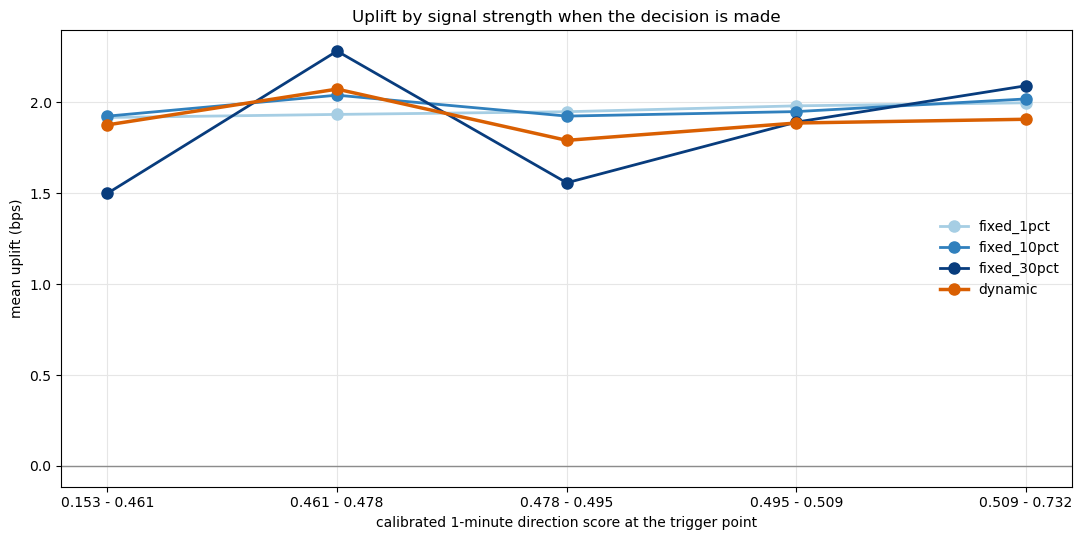
This does not mean the direction model is useless. It already did its job by selecting the entry. It means that the same one-minute score does not contain enough new information, once the profit barrier has been reached, to manage the final few seconds of the exit better than a fixed rule. Entry confidence and exit timing are related questions, but they are not the same question.
What I would put into the system
The practical conclusion is pleasantly simple: start with a fixed 10% risk budget and do not overfit the second decimal place. The broad plateau around the optimum matters more than the exact winner, and the consistency across months makes the result more convincing than a single aggregate number.
The live take-profit strategy has a little more machinery than this isolated test. A barrier breach must hold briefly before trailing begins, and the live band is measured relative to the take-profit barrier rather than reproducing this backtest formula exactly. It also has to deal with real fills, commissions, exchange step sizes and closing orders. So I treat this result as evidence for the design and its default—not as a claim that the production path has been simulated line for line.
I still like the dynamic idea, but it now has a higher bar. To justify shipping it, I would want a signal built specifically for continuation after the barrier, not a repurposed entry signal with a more complicated mapping. Until then, the fixed rule is easier to explain, easier to operate and, on this sample, marginally better.